The Best Project Management Training Isn't a Certificate, it's Volunteering
Forget expensive certifications and formal training. The best hands-on training for a Project Manager is happening right now in your Employee Resource Groups (ERGs). Discover how leading an ERG is a real-world proving ground that sharpens your most critical skills - from running complex global campaigns to mastering the art of influence when you have no formal authority.

Senior Program Manager
First of all, what's an ERG? An Employee Resource Group (ERG) is an entirely employee-led initiative where we contribute to causes we genuinely care about, while building a community and getting things that matter done.
In Project Management Offices, we often talk about frameworks, tools, and certifications. But some of the most complex projects aren't found in our product roadmaps: they are happening right now in our ERGs.
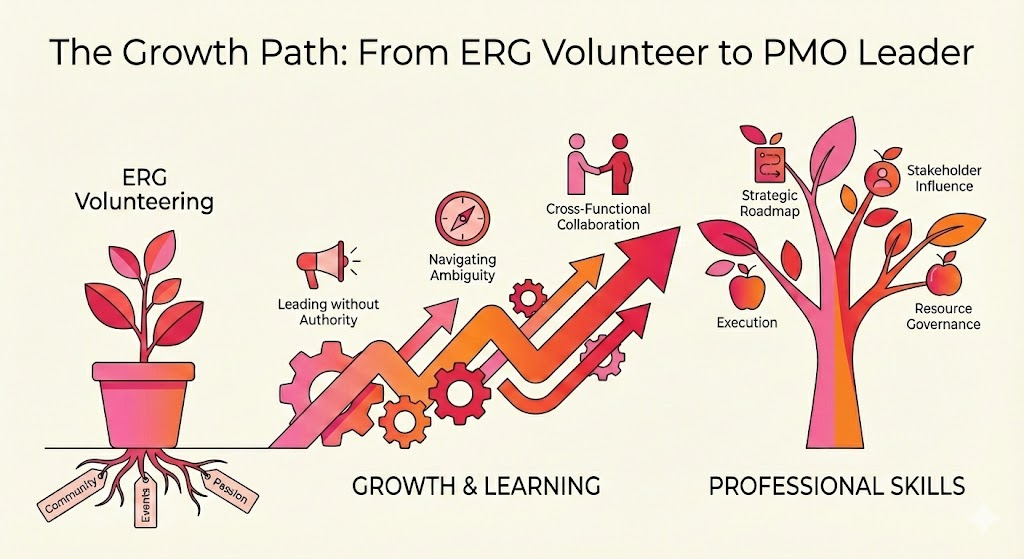
If you are looking to sharpen your project management "muscles," volunteering for an ERG is a high-stakes leadership laboratory. Here is how ERG leadership maps directly to the core skills we use every day in the PMO.
Scope Definition & Roadmap Building
Every successful project begins with a "why." In an ERG, we often start from zero, much like a startup phase. This requires the ability to define a mission, secure a budget, and build a roadmap where no structure previously existed. Whether it's launching a new "baby" ERG, defining the annual goals for a global pillar, or working on a new project, we are practicing the art of founding a culture and driving impact outside of a product context. These initiatives teach us to align organizational needs with community passion, turning a vague idea into a structured program of approvals, events, panels, and partnerships.
Operational Execution in Complex Ecosystems
Leading a major initiative, such as a global awareness campaign for Pink October, is a masterclass in operational execution. Within a large-scale corporate ecosystem of 16,000+ people, we must learn to navigate internal networks quickly and efficiently. These projects involve mobilizing dozens of volunteers, partnering with external NGOs, managing budgets and approvals that sometimes exceed our day-to-day role. By executing these high-visibility programs, we learn to raise the bar for impact, and we get to see a real and tangible impact.
Leading Without Authority
Perhaps the most critical skill for any Project Manager is the ability to influence without a reporting line. In an ERG, every contributor is a volunteer. We cannot rely on hierarchy to get things done; instead, we must rely on shared purpose, clear communication, and authentic leadership. When we manage a pillar involving 30+ volunteers, we are practicing people management at scale. Our success becomes tied to the growth of others, and I've seen it happen: a software engineer becomes a better communicator, or a junior employee manages senior stakeholders.
Cross-Functional Exposure and Peer Learning
One of the unique advantages of an ERG is the opportunity to step outside of our immediate departments. In an ERG, we work with people who come from all sides of the organization, from Engineering and Sales to HR and Finance. This environment provides exposure to topics and technical skills we wouldn't otherwise encounter in our daily roles. As we naturally expand our network and field of possibilities, we learn how different functions solve problems, allowing us to bring a more holistic, well-rounded perspective back to our PMO projects.
Navigating the Unknown
ERG projects rarely come with a pre-defined playbook. They require us to create order out of chaos and build sustainable processes that empower others. We learn to manage stakeholders across all seniority levels, make impactful decisions under pressure, and derive strategy from ambiguity. This "managerial muscle" is exactly what is needed to lead cross-functional projects where boundaries are blurred and the path forward isn't always clear.
The Governance Side: Resources, Change, and Data
In an ERG, we are essentially running a business-within-a-business, which requires a high level of project governance. Because we operate with limited time and competing priorities, we must master Resource Management and Capacity Planning: learning how to prioritize high-impact initiatives when team velocity is fluid. Furthermore, we practice Change Management by driving cultural adoption for new programs, ensuring our initiatives don't just launch, but actually stick. Finally, we lean heavily into Benefits Realization and Data Storytelling. To justify budgets and executive sponsorship, we learn to define what "success" looks like, collecting data and turning raw metrics into a compelling narrative of ROI and community impact.
Why it Matters
Volunteering in an ERG is not just about "giving back." It is about becoming a force multiplier. The skills built while managing these initiatives, including budget ownership, stakeholder alignment, and strategic communication, are the exact same skills that define a world-class PMO professional.
Want to challenge yourself, learn new skills, and contribute to something that matters to you? Join an ERG!